
Cooling, Hashrate and the Daily Payout
A miner that runs hot does not stop earning all at once; it earns less, quietly, as firmware trims frequency to protect the boards. At 60 TH/s, current conditions produce 2.692e-05 BTC a day, worth $2.28 at $84,692 per BTC, or $2.19 after the listed 4% on the block-reward component. Cooling is the part of the setup that keeps that figure steady.
Key takeaways
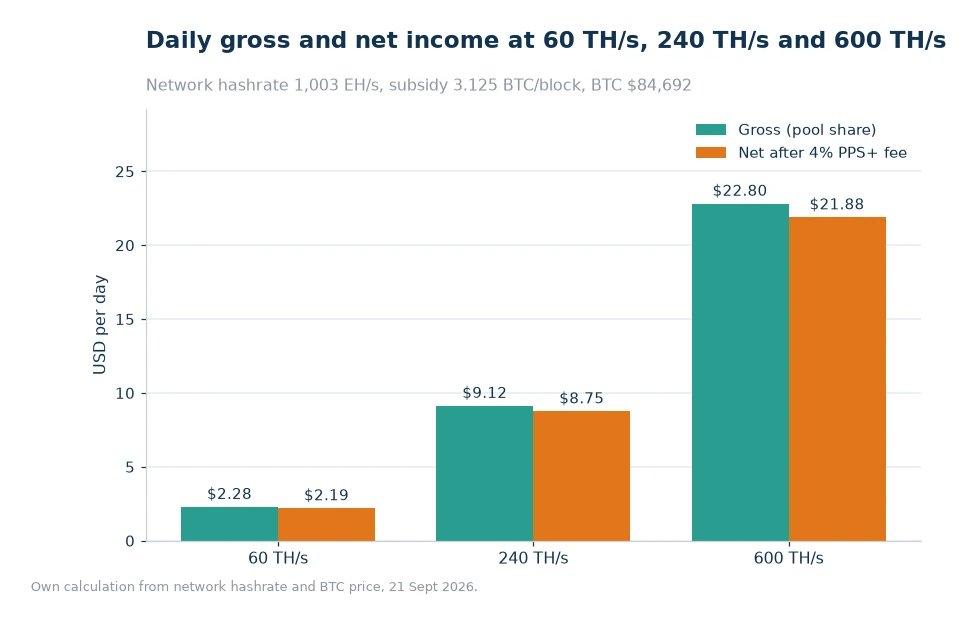
- At 60 TH/s, daily output is 2.692e-05 BTC, or $2.28 gross and $2.19 net of the listed 4% on the block-reward component.
- At 600 TH/s the same inputs give 0.00026916 BTC a day, $22.80 gross and $21.88 net.
- A derated machine can lose more output in a week than the listed pool fee costs in a month.
- PPS+ settles hourly against current difficulty; PPLNS settles after 6 confirmations across the last 5 difficulty rounds.
Heat is the constraint that shows up in the payout
Hash boards have a thermal limit, and firmware protects them by reducing frequency or voltage when the limit is approached. The machine keeps running, the dashboard still shows a number, and the daily payout quietly falls. Because the change is gradual, it is easy to attribute to difficulty or price rather than to the room. The way to tell the difference is to compare the reported hashrate with the nameplate figure over several days.
Cooling also costs power. A fan or an air conditioner adds to the meter reading without adding a single hash, so the goal is not the coldest possible room. It is the least cooling that keeps the machines at their rated speed. That balance point is different for every setup, and it moves with the season, the dust load and the number of machines in the space.
What a steady room buys
A steady room buys predictability. When the intake air is consistent, the reported hashrate stays close to the rated figure, and the daily payout tracks the formula instead of drifting below it. That predictability is what makes a monthly budget possible. A room that swings with the afternoon sun produces a payout that swings too, and the average is usually lower than a good day suggests.
The ViaBTC Bitcoin Mining account reports the hashrate that was actually submitted, so a sustained gap between that number and the nameplate is a cooling or power-delivery signal. PPS+ pays hourly against current difficulty, which means a short dip shows up quickly in the balance. PPLNS pays after 6 confirmations across the last 5 difficulty rounds, which can hide a short dip inside a longer window.
Three tiers at a constant room temperature
The rows below assume the machines are running at their rated speed, which is the whole point of the cooling work. The network inputs are constant, so the only variable is the number of machines. The net column applies the listed 4% to the block-reward component and excludes the power used by fans and cooling.
| Hashrate | BTC per day | Gross USD per day | Net USD per day |
|---|---|---|---|
| 60 TH/s | 0.00002692 | $2.28 | $2.19 |
| 240 TH/s | 0.00010768 | $9.12 | $8.75 |
| 600 TH/s | 0.00026916 | $22.80 | $21.88 |
The middle row is four times the first, and the top row is ten times the first, so the gross figures scale in the same ratio. If the measured payout at 240 TH/s is materially below four times the 60 TH/s figure, the cause is usually not the pool formula. It is a derated board, a hot spot in the rack or a power supply that is not delivering its rated output.
Derating, dust and fan curves
Dust is the slowest of the cooling problems and the easiest to ignore. It builds on heat sinks and fan blades, reduces airflow, and pushes the boards toward the thermal limit. A machine that ran at its rated speed in winter may derate in summer without any change to its firmware. Cleaning the intake and the heat sinks is unglamorous maintenance with a direct effect on the daily figure.
Fan curves are the other lever. A more aggressive curve moves more air and consumes more power; a quieter curve saves fan power and risks derating. The right setting is the one that keeps the reported hashrate at the rated figure with the lowest total power draw, fans included. That is a measurement, not a preference, and it is worth taking once per season rather than once at installation.
Monitoring the daily figure
The daily payout is a better cooling metric than a temperature reading because it combines the room, the machines and the pool into one number. Compare the payout with the formula at the same difficulty and price. A gap that persists for several days is a signal to inspect the hardware. A gap that appears for one day and disappears is more likely to be a pool or network event, especially under PPLNS.
The next difficulty estimate is minus 2.12%, which would raise output per terahash slightly if it holds. That makes the formula-based comparison a moving target, so update the expected figure after the adjustment before concluding that the hardware has a problem. Price moves are separate again: they change the dollar value of the payout without changing the coin count or the room temperature.
Worked example
Take 60 TH/s and run the chart arithmetic with the inputs read on 21 Sept 2026.
- Daily BTC per TH/s is 450 divided by 1,003,000,000, which equals 4.4865e-07.
- Multiply by 60: 4.4865e-07 times 60 equals 2.6919e-05 BTC, shown as 2.692e-05.
- Multiply by the BTC price: 2.6919e-05 times $84,692 equals $2.28 gross.
- Apply the listed 4% to the block-reward component: 4% of $2.28 is $0.09, leaving $2.19 net.
- Multiply by four for 240 TH/s: 0.00010768 BTC, $9.12 gross and $8.75 net.
- Multiply by ten for 600 TH/s: 0.00026916 BTC, $22.80 gross and $21.88 net.
- Thirty days at 600 TH/s nets about $656.40 before power, which is the figure a derated machine is quietly reducing.
Cool the room, then check the meter
A hosted Mining Farms arrangement can remove the cooling problem from the operator's list, but it replaces it with a hosting charge that should be compared on the same daily basis. Whether the room is yours or someone else's, the test is the same: does the measured hashrate stay at the rated figure, and does the payout match the formula at current difficulty?
Write down the expected daily BTC, the actual daily BTC and the difference for a week. If the gap is small, the cooling is doing its job. If it is not, clean the intake, check the fan curve and inspect the power delivery before blaming the pool. The payout is usually reporting a physical problem rather than causing one.
Frequently asked questions
How much payout does a hot machine lose?
There is no fixed percentage, because firmware derating depends on the model and the room. The loss shows up as a reported hashrate below the nameplate figure, which reduces the daily BTC in direct proportion.
Does cooling cost more than the output it protects?
It can if the room is overcooled. The aim is the least fan and cooling power that keeps the machines at rated speed, measured against the daily payout rather than set by feel.
Does PPS+ hide a short cooling dip?
No. PPS+ settles hourly against current difficulty, so a dip appears in the next payment. PPLNS pays after 6 confirmations across the last 5 difficulty rounds, which can spread a short dip across a longer window.
Measure the gap for a week
Record the expected daily BTC from the formula and the actual payout for seven days. At 60 TH/s the expected figure is 2.692e-05 BTC a day, or $2.28 gross at $84,692. A persistent shortfall is a hardware or cooling issue; a one-day shortfall is noise. Seven days is long enough to see the pattern and short enough to fix it before a season changes.
Sources: the ViaBTC homepage for the pool setup and the fee schedule for the listed 4% and 2% rates. Network hashrate 1,003 EH/s, difficulty 132.76 T, subsidy 3.125 BTC per block, 450 BTC daily and BTC $84,692 were read 21 Sept 2026, published 22 Oct 2026[1]. Every dollar figure is arithmetic on those inputs and moves when they move.